
Strategic Market Intelligence — Analysis Series. Prepared by Jim Ikpehai, Mediology Nigeria. Published April 2026.
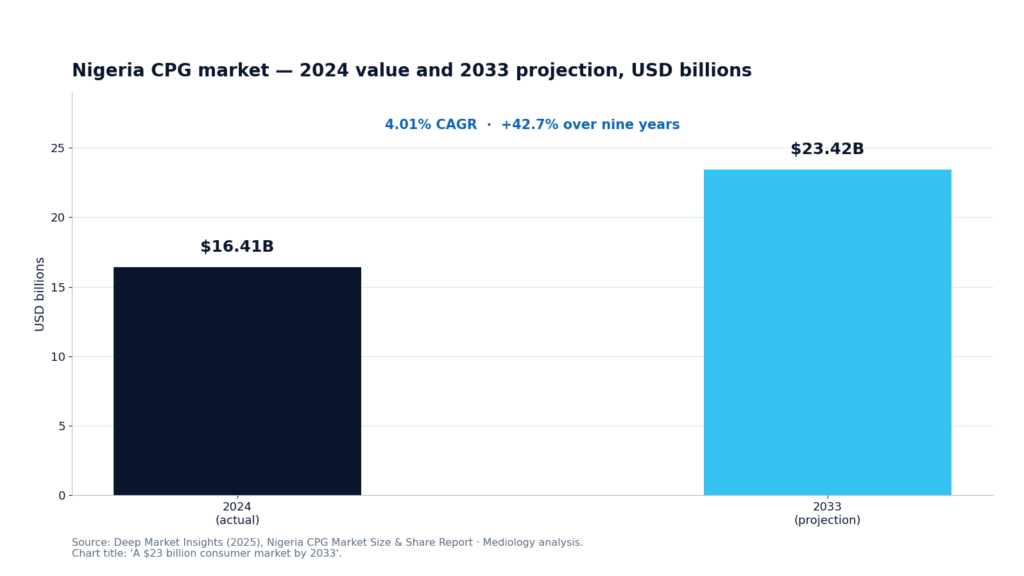
This brand growth Nigeria framework, built on the Ehrenberg-Bass Institute’s evidence-based marketing science, presents a comprehensive approach to growing brands in Nigeria. It examines how brands grow through mental availability — being thought of — and physical availability — being easy to buy — exploring Category Entry Points as purchase triggers and Distinctive Brand Assets as memory cues. The headline numbers frame the prize: a $16.41 billion CPG market in 2024, projected to reach $23.42 billion by 2033, in a country of 220 million-plus people where 72% of retail still runs through open markets.
| Headline stat | Value |
|---|---|
| Share of retail through open markets | 72% |
| Nigeria CPG market value, 2024 | $16.41B |
| Projected market value by 2033 | $23.42B |
| Market CAGR, 2024–2033 | 4.01% |
| Population — Africa’s largest consumer market | 220M+ |
| Projected middle-class consumers | 45M |
1. Executive abstract
Growth comes from being easy to mind and easy to find
This brand growth Nigeria framework, built on the Ehrenberg-Bass Institute’s evidence-based marketing science, presents a comprehensive approach to growing brands in Nigeria. It examines how brands grow through mental availability — being thought of — and physical availability — being easy to buy — exploring Category Entry Points as purchase triggers and Distinctive Brand Assets as memory cues.
The twin levers
- Mental availability — the probability the brand comes to mind in relevant buying situations
- Physical availability — the ease with which buyers can find and purchase the brand across channels, formats and moments
The operating tools
- Category Entry Points (CEPs) — the needs, occasions and situations that trigger category thought
- Distinctive Brand Assets (DBAs) — the colours, codes, characters and sounds that cue the brand instantly
Why Nigeria, why now
With Nigeria’s Consumer Packaged Goods market valued at USD 16.41 billion in 2024 and projected to reach USD 23.42 billion by 2033, these principles are essential for sustainable growth in a market defined by rapid urbanization, a rising middle class and uniquely complex distribution.
Keywords: Mental Availability · Physical Availability · Category Entry Points · Distinctive Brand Assets · Nigerian Market · Ehrenberg-Bass Institute
2. The science of brand growth
Penetration, not loyalty, is the growth engine
Decades of empirical research from the Ehrenberg-Bass Institute for Marketing Science — led by Professor Byron Sharp and Professor Jenni Romaniuk — have fundamentally transformed the marketing landscape, challenging conventional wisdom with evidence-based principles for how brands actually grow.
The traditional doctrine
- Differentiation as the primary competitive weapon
- Narrow targeting of specific consumer segments
- Brand loyalty cultivation as the growth driver
The empirical reality
- Brands grow primarily by increasing their customer base — penetration
- Light buyers, not loyalists, hold the growth headroom
- Broad reach outperforms narrow persuasion
Purchasing data across numerous categories and markets reveals a consistent pattern: brands win by being bought by more people, more easily — not by cultivating extreme loyalty among a select few. This journal applies those evidence-based principles to Nigeria’s dynamic market, characterized by rapid urbanization, a growing middle class (projected at 45 million consumers with rising disposable income) and unique distribution challenges.
The strategic consequence
Nigeria presents significant opportunities for brands that understand how to build mental and physical availability effectively. The winners will not be the most differentiated brands — they will be the most available: present in the mind at the moment of need, and present on the shelf, screen or stall where that need is answered.
3. The availability framework for brand growth Nigeria
Four numbers measure the mind; three dimensions build the shelf
The Mental and Physical Availability Framework provides a simple but powerful approach to brand growth. Mental availability is the probability a brand comes to mind in relevant buying situations; physical availability is the ease with which buyers can find and purchase it across channels, formats and moments.
Mental availability — the four Ehrenberg-Bass metrics
Mental Penetration · MPen — Share of category buyers linking the brand to at least one CEP. Indicates the breadth of the brand’s mental footprint.
Network Size · NS — Average number of CEPs associated with the brand. Measures versatility across buying situations.
Mental Market Share · MMS — The brand’s presence across all CEPs relative to competitors. Correlates strongly with actual market share.
Share of Mind · SOM — CEP associations among brand knowers only. Reveals strength among engaged consumers.
Physical availability — the three dimensions
Presence — Being where buying happens. In Nigeria: traditional open markets (72% of retail sales), convenience stores (25%), e-commerce (6%), modern trade (3%).
Prominence — Being easy to find within the sales environment — shelf placement, search visibility and point-of-sale presence.
Portfolio — Appropriate pack sizes, formats and price points. Nigeria’s “sachetization” trend exemplifies portfolio adaptation to local conditions.
4. Category entry points
Own the moment, not the attribute
Category Entry Points are the needs, occasions or situations that lead consumers to think about a product category. Developed by Sharp and Romaniuk, CEPs are the triggers that initiate the consumer journey — the building blocks of mental availability.
CEPs shift brand strategy from abstract attributes to tangible, real-world moments. In soft drinks, consumers think of products “when feeling thirsty after exercising” or “while watching a game.” By linking to specific situations, brands increase the likelihood of recall when those moments arrive.
Table 1 · The 7W framework for CEP identification — Nigerian applications
| Dimension | The question | Nigerian application |
|---|---|---|
| Why | What motivates consumers? | Family provision, status, convenience, value |
| When | What occasions trigger consideration? | Salary week, weekends, festive periods |
| Where | Where are consumers? | Open markets, traffic, church/mosque, workplace |
| While | What co-activities occur? | Watching TV, commuting, socializing |
| With whom | Who are consumers with? | Extended family, community gatherings |
| With what | What associated products? | Complementary purchases, substitutes |
| How feeling | What emotional states? | Pride, belonging, aspiration, security |
Strategic application
Identify the most common CEPs through research, then build associations through marketing campaigns, packaging design and product development. Focus on the most valuable CEPs rather than too many simultaneously — depth of association beats breadth of ambition.
5. Distinctive brand assets
If buyers can’t link it to you, it isn’t an asset
Distinctive Brand Assets — also called brand codes — are learned associations that help consumers notice, recognize, remember and think of a brand. They encompass colours, logos, icons, characters, packaging, patterns, shapes and audio devices: non-verbal cues that make brands instantly recognizable at speed, at distance, and across contexts.
Fame
The percentage of category buyers who correctly link an asset to the brand when shown it in isolation. High fame means the cue triggers the brand without the name.
Uniqueness
How exclusively the asset is linked to the brand versus competitors. High uniqueness means the cue cannot be claimed by a rival.
The 3–5 rule
Concentrate on three to five core assets. Larger sets dilute exposure and slow memory building — consistency compounds.
Table 2 · DBA categories and Nigerian applications
| Category | Examples | Nigerian application |
|---|---|---|
| Visual | Colours, logos, shapes, patterns | Packaging colours visible in crowded markets |
| Verbal | Taglines, jingles, brand names | Memorable phrases in local languages |
| Character | Mascots, spokespeople | Culturally relevant characters |
| Sonic | Jingles, sound logos | Audio branding for radio advertising |
| Physical | Packaging shapes, product forms | Distinctive bottles, appropriate pack sizes |
The core principle
If buyers can quickly and correctly link these cues to a brand — and not to competitors — mental availability increases. Every naira spent on an unowned cue is a naira spent building a rival’s salience.
6. Empirical laws of brand growth
Five laws that hold across every category studied
Byron Sharp’s research identifies law-like patterns in buyer behaviour that hold across categories and markets. Strategy built against these laws is strategy built against the evidence.
Table 3 · Key empirical laws of brand growth
| Law | Description | Strategic implication |
|---|---|---|
| Double Jeopardy | Small brands have fewer buyers, who are also slightly less loyal | Growth comes from penetration, not loyalty programmes |
| Pareto (60/20) | Roughly 60% of sales come from the top 20% of customers | Light buyers collectively matter significantly |
| Buyer Moderation | Heavy buyers buy less over time; light buyers buy more | Focus on acquiring new buyers, not increasing frequency |
| Natural Monopoly | Big brands attract more light category buyers | Penetration drives scale advantages |
| Prototypicality | Category attributes score higher than unique ones | Differentiation is weaker than traditionally believed |
Core principle
These laws demonstrate that brands grow by being easy to buy and easy to remember — not by being different. Marketing strategy should prioritize broad reach, consistent distinctive assets and ubiquitous distribution over niche targeting and differentiation campaigns.
7. Common mistakes in brand development
Six ways brands waste their budgets
Despite evidence-based guidance, brands consistently make predictable errors. Understanding these mistakes is essential to avoiding them.
1 · Over-reliance on differentiation
Heavy investment in communicating difference — yet consumers perceive brands as largely interchangeable. Be memorable, not unique.
2 · Narrow targeting
Targeting specific demographics limits reach and ignores that growth comes from light buyers across all segments. Mass marketing outperforms.
3 · Loyalty over penetration
The belief that retention beats acquisition misallocates resources. Growth comes from increasing buyer numbers.
4 · Inconsistent brand assets
Frequent changes to logos, colours or messaging prevent strong memory structures. Consistent, long-term exposure builds recognition.
5 · Cultural misalignment
In Nigeria, brands often prioritize visibility over cultural understanding. African consumers recognize when narratives are imported rather than authentically engaged.
6 · Neglecting physical availability
Even brands with strong mental availability fail if consumers cannot purchase them easily. Distribution coverage is foundational in Nigeria’s fragmented retail environment.
The pattern behind the mistakes
Every one of these errors privileges persuasion over presence. The correction is systematic: audit each decision against the question — does this make us easier to mind and easier to find?
8. Best practices for building availability
The availability checklist
Building availability is operational, not aspirational. Each lever has concrete actions and a matching measurement discipline.
Building mental availability
- Identify and prioritize CEPs — research common entry points; focus on the most valuable
- Develop distinctive assets — create 3–5 core assets; test fame and uniqueness regularly
- Maintain broad-reach media — prioritize channels reaching the widest category-buyer audience
- Ensure creative consistency — deploy assets identically across all touchpoints
Building physical availability
- Maximize distribution coverage — traditional markets, modern trade, convenience, e-commerce
- Optimize prominence — shelf placement and findability in every environment
- Develop the right portfolio — match packs, formats and price points to local patterns
- Build distribution partnerships — strong distributor relationships are essential
Table 4 · Availability building checklist — actions and measurement
| Dimension | Key actions | Measurement |
|---|---|---|
| Mental availability | CEP research, DBA development, broad-reach media | MPen, Network Size, MMS |
| Physical availability | Distribution expansion, prominence optimization | Numeric distribution, OSA |
| Integration | Consistent assets across all touchpoints | Brand recognition, attribution |
| Adaptation | Local market customization | Market share, penetration growth |
9. The Nigerian market
A young, urbanizing, $16 billion prize
Nigeria’s Consumer Packaged Goods market was valued at USD 16.41 billion in 2024 and is projected to reach USD 23.42 billion by 2033. Three structural drivers underpin the trajectory.
Urbanization
Urban population projected to reach 220 million, driving demand for modern retail formats and branded convenience.
Rising middle class
Expected to grow to 45 million, with higher disposable incomes and appetite for premium propositions.
Digital transformation
E-commerce growing rapidly, particularly among urban youth — a new physical-availability frontier.
9. The Nigerian market — Regions
Six regions, six playbooks
Nigeria is not one market. Distribution strategy, portfolio design and media weight must flex to sharply different regional structures.
Table 5 · Regional market characteristics and channel strategy
| Region | Key states | Characteristics | Strategy |
|---|---|---|---|
| South-West | Lagos, Oyo, Ogun | Modern trade; urban; premium demand | Supermarkets, e-commerce focus |
| South-East | Anambra, Enugu, Imo | Trading culture; Onitsha hub | Wholesale, value positioning |
| South-South | Rivers, Delta | Oil industry; higher purchasing power | Modern trade, premium segments |
| North-West | Kano, Kaduna | Largest population; traditional retail | Traditional markets, sachet formats |
| North-East | Borno, Adamawa | Emerging recovery; price-sensitive | Gradual expansion, affordability |
| North-Central | Abuja FCT, Plateau | Administrative centre; mixed urban-rural | Modern + traditional trade |
Market opportunity — the local champions are rising
Multinational exits have created space for local businesses. Bokku Mart now operates 60+ Lagos stores, surpassing ShopRite, while OmniRetail has launched 50+ franchises serving underserved communities. Availability built on local infrastructure is beating imported scale.
9. The Nigerian market — Channels
Distribution is the strategy
Physical availability in Nigeria means mastering a fragmented, overwhelmingly traditional retail landscape — while building early positions in the formats growing fastest.
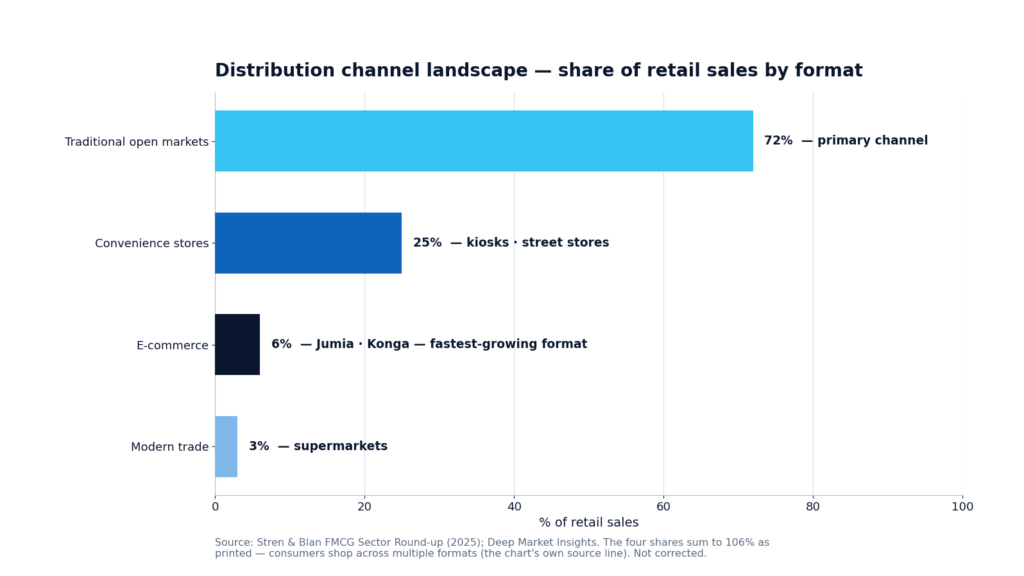
Traditional open markets · 72%
The primary channel. Retailers purchase 80%+ from wholesalers — wholesale relationships are the real distribution asset.
Convenience stores · 25%
Street stores and kiosks offering low prices and convenient access — the everyday top-up mission.
Modern trade · 3%
Supermarkets concentrated in Lagos, Abuja and Port Harcourt — small share, high visibility and premium signalling.
E-commerce · 6%
Growing via Jumia and Konga, particularly among younger consumers — the fastest-compounding format.
10. Strategic recommendations
Three playbooks, one direction
The framework translates into distinct priorities by market position — and a shared discipline for every brand.
For new market entrants
- Physical availability first — robust distribution before heavy advertising investment
- Culturally relevant DBAs — local languages and cultural symbols
- Start with core CEPs — the 3–5 most common entry points
- Distribution partnerships — local expertise is invaluable in Nigeria’s complex landscape
For established brands
- Expand Network Size — increase CEP associations where penetration is established
- Optimize portfolio — continuously adapt packs, formats and prices
- Strengthen distinctive assets — audit fame and uniqueness; reinforce high performers
- Expand geographically — North-West and North-East are untapped potential
For all brands
- Measure what matters — MPen, Network Size, MMS — not traditional awareness
- Maintain broad-reach media — TV, radio, outdoor, complemented by digital
- Build for the long term — memory structures require sustained investment
- Embrace omnichannel — extend physical availability to digital platforms
Implementation framework
Phase 1 · Foundation — Distribution build-out, CEP research and distinctive-asset development — the infrastructure of availability.
Phase 2 · Building — Broad-reach media weight and consistent asset execution across every touchpoint.
Phase 3 · Expansion — Network-size growth and geographic expansion into under-served regions.
11. Conclusion
Context, continuity, credibility
The evidence-based marketing science developed by the Ehrenberg-Bass Institute provides a robust framework for brand growth applicable across markets and categories. Mental and physical availability — supported by Category Entry Points and Distinctive Brand Assets — offer a clear pathway for sustainable growth in Nigeria’s dynamic market.
The opportunity is substantial: over 220 million people, rapid urbanization and a growing middle class. Yet the complexity of the distribution landscape, regional diversity and economic volatility demand thoughtful adaptation of global principles to local reality.
Key success factors
Be there
- Physical availability through comprehensive distribution coverage
- Portfolio adaptation to local purchasing patterns and price points
- Cultural relevance in every asset and activation
Be remembered
- Mental availability via CEP-linked, consistent distinctive assets
- Broad-reach marketing sustained over the long term
- Measurement discipline — progress tracked with availability metrics
The final word
Brands embracing these principles while respecting Nigeria’s unique characteristics will be positioned for sustainable growth. The authority of authenticity is earned through context, continuity and credibility. “Brands grow by being easy to buy and easy to remember. Everything else is commentary.”
See our Services page for the six integrated disciplines behind this approach.
References
Sources & citations
The framework and figures in this journal draw on the foundational marketing-science literature and current Nigerian market intelligence below.
- 1. Sharp, B. (2010). How Brands Grow: What Marketers Don’t Know. Oxford University Press.
- 2. Deep Market Insights (2025). Nigeria Consumer Packaged Goods Market Size & Share Report. deepmarketinsights.com
- 3. Umbrex (2026). Mental and Physical Availability Framework. umbrex.com/resources/frameworks
- 4. Merlien Institute (2023). The Power of Mental Availability in Brand Tracking. merlien.com
- 5. Ehrenberg-Bass Institute (2026). Easy to Find: Being Where B2B Buying Happens. marketingscience.info
- 6. Insights Association (2025). Category Entry Points (CEPs): The Missing Link in Your Brand Growth Strategy. insightsassociation.org
- 7. Distinctive BAT (2025). Distinctive Brand Assets. distinctivebat.com
- 8. Umbrex (2026). Distinctive Brand Assets Framework (Ehrenberg-Bass). umbrex.com/resources/frameworks
- 9. AFL Frontier Notes (2026). What Brands Get Wrong When Entering African Markets. aflfrontiernotes.substack.com
- 10. Stren & Blan (2025). FMCG 2024 Sector Round-up and 2025 Forecast. strenandblan.com
About the author
Jim Ikpehai
Managing Consultant · Mediology Nigeria Limited, Lagos
Results-driven marketing communications strategist with over 15 years of experience in brand building, brand development and management. A trusted consultant to global and local brands including Samsung, Reliance HMO, Polo Swarovski, FBN Holdings, M-KOPA, Honda Nigeria, Daraju Industries and De Trans — delivering 360° marketing, communication strategies, media planning and buying, digital marketing, SEO, content strategy and marketing analytics.
Education
- Ph.D. Economics — Sustainable Growth & Development (in view), University of Lagos
- M.Sc. Economics — Growth & Development, Monetary & Energy Economics, University of Lagos
- B.Sc. Economics — University of Lagos
- Level 6 Diploma in Strategic Marketing — Chartered Institute of Marketing (CIM), UK
Career highlights
- Managing Consultant — Mediology Nigeria Ltd (2025–present)
- Director of Planning & Strategy — Solid Media Nigeria (2022–2025)
- Head, Media Planning & Strategy — HoiSales Nigeria (2020–2022)
- Head, Planning / Insight & Analytics — All Seasons Zenith (Publicis Groupe), Lagos (2014–2020)
- Senior Manager, Research / Planning & Innovation — All Seasons Zenith (Publicis), 2013–2014
- Manager, Data Analytics & Innovation — MediaCom (WPP), 2011–2013
Memberships & recognition
- Juror, Young Lions National Competition (Cannes Lions pathway) — 2024 & 2025
- Juror, Pitcher Awards — 2024
- Panelist, Social Media Week Lagos — 2019
- Fellow, Institute of Management Consultants of Nigeria (FIMC)
- Associate Member, Advertising Practitioners Council of Nigeria (APCON)
- Member, Chartered Institute of Marketing (CIM), UK
15+ years in marketing communications · WPP · Publicis global network experience · ALAT launch team — Nigeria’s first digital bank · 2× Young Lions Juror · 2024 & 2025
jim@mediologyng.com · +234 703 630 0230 · linkedin.com/in/jimikpehai75564295
Frequently asked questions
What is mental availability?
Mental availability is the probability a brand comes to mind in relevant buying situations. It is measured with four Ehrenberg-Bass metrics: Mental Penetration (the share of category buyers linking the brand to at least one CEP), Network Size (the average number of CEPs associated with the brand), Mental Market Share (the brand’s presence across all CEPs relative to competitors) and Share of Mind (CEP associations among brand knowers only).
What is physical availability?
Physical availability is the ease with which buyers can find and purchase a brand across channels, formats and moments. It has three dimensions: presence (being where buying happens), prominence (being easy to find within the sales environment) and portfolio (appropriate pack sizes, formats and price points). In Nigeria it means mastering open markets, which carry 72% of retail sales, while building early positions in convenience stores, modern trade and e-commerce.
What are Category Entry Points?
Category Entry Points are the needs, occasions or situations that lead consumers to think about a product category — the triggers that initiate the consumer journey and the building blocks of mental availability. The 7W framework identifies them by asking why, when, where, while, with whom, with what and how feeling, with Nigerian applications ranging from salary week and festive periods to open markets, traffic and church or mosque.
What are Distinctive Brand Assets?
Distinctive Brand Assets — also called brand codes — are learned associations that help consumers notice, recognize, remember and think of a brand: colours, logos, icons, characters, packaging, patterns, shapes and audio devices. They are judged on fame (how many category buyers link the asset to the brand) and uniqueness (how exclusively it is linked), and brands should concentrate on three to five core assets.
Where can I get the full report?
The full 18-page Building Mental & Physical Availability journal is available to download below. For a tailored reading of the framework for your business, or a state-level deep dive, contact Mediology Nigeria at info@mediologyng.com or visit 1 Montgomery Road, Yaba, Lagos.
This journal was prepared by Jim Ikpehai, Mediology Nigeria — data-driven marketing communications excellence. For the full framework, including every table and the underlying data, download the complete report below.