
Strategic Market Intelligence — Analysis Series. Prepared by Jim Ikpehai, Mediology Nigeria. Published April 2026. Research period 2024–2025.
A war 4,500 kilometres away repriced Nigerian airtime. The Iran-Israel war’s disruption of the Strait of Hormuz — a channel moving 20 million barrels of crude daily — sent Brent crude from $72 to over $120 a barrel, and in Nigeria that shock landed directly in the fuel tank: PMS rose from ₦238 a litre in May 2023 to ₦1,025+ in 2024, a surge of 330%. Media houses now pay roughly four times the grid tariff for every kilowatt-hour they generate themselves, broadcast stations have cut transmission hours, and headline inflation peaked at 34.19% in June 2024, eroding the audience advertisers pay to reach. Yet the sector it hit is a resilient ₦605.2 billion industry, projected to reach ₦893 billion by 2028 — and every ₦1 spent on marketing communications still generates ₦16.50 in GDP.
| Headline stat | Value |
|---|---|
| PMS surge | +330% — ₦238 → ₦1,025+ per litre |
| Sector value, 2023 | ₦605.2 billion |
| Diesel vs grid cost per kWh | 4× |
| GDP generated per ₦1 of marketing spend | ₦16.50 |
| Brent crude | $72 → $120+ per barrel (+67%) |
| Inflation peak | 34.19% in June 2024 |
| Projected sector value by 2028 | ₦893 billion |
1. Executive summary
A war 4,500 kilometres away repriced Nigerian airtime
This research traces the transmission mechanism from the Iran-Israel war through global petroleum pricing to the operating costs and consumer behaviour that define Nigeria’s marketing and advertising sector. The conflict’s disruption of the Strait of Hormuz — a channel moving 20 million barrels of crude daily — triggered a cascade that has fundamentally altered the environment for media houses, advertising agencies and media monitoring organizations.
| Headline figure | Value |
|---|---|
| Brent crude per barrel | $120+ — +67% from $72 |
| PMS per litre in 2024 | ₦1,025+ — from ₦238 in May 2023 |
| Projected sector value by 2028 | ₦893B — 1.08% of GDP |
Key findings
Media houses pay 4× more running diesel generators than grid tariffs per kWh. Inflation hit 31.7% in 2024, severely eroding consumer purchasing power. Broadcast stations have cut transmission hours under fuel costs. And the stakes are national: every ₦1 spent on marketing communications generates ₦16.50 in GDP.
Research objectives
Examine the transmission from global oil shocks to Nigeria’s PMS pricing · analyze the impact of rising PMS prices on media house OPEX and sustainability · assess the effect on media monitoring and advertising research capability · evaluate implications for consumer purchasing power and advertising effectiveness.
The bottom line
Nigeria’s paradox — an oil producer importing over 90% of refined petroleum — means global shocks transmit directly into studio generators, transmitter halls and household budgets. The marketing sector now operates on the most expensive energy in its history, against the weakest consumer wallet in two decades.
2. The conflict — global economic shockwaves
The Strait of Hormuz is 21 miles wide — and it holds Nigeria’s fuel price
The narrow passage between Iran and Oman moves roughly 20 million barrels of crude oil daily — one-fifth of global petroleum consumption. The conflict’s escalation in February 2026 brought the vulnerability of global energy supply chains into stark relief: insurers cancelled coverage, war-risk premiums jumped 300–500%, and Brent crude repriced from $72 to over $120 a barrel — the most significant oil shock since 2022.
Table 1 · Regional vulnerability to the Hormuz disruption
| Region / economy | Vulnerability factor | Impact assessment |
|---|---|---|
| Asia (aggregate) | 80%+ oil import dependency | Severe — accounts for 70% of Hormuz transits |
| Japan | 90% Middle East crude imports | Critical — limited strategic reserves |
| South Korea | 70% Middle East crude imports | High — industrial economy vulnerable |
| European Union | 10–15% Hormuz dependency | Moderate — diversified supply sources |
| Africa (net importers) | Limited reserves, thin fiscal buffers | Severe — disproportionate burden |
Fertilizer and food price contagion
Gulf countries supply 45% of global sulfur — a critical input for nitrogen fertilizer. With fertilizer prices projected to double, the conflict threatens a global food price crisis, compounding the inflationary pressures already bearing down on Nigerian households.
Critical insight
For Nigeria — a net fuel importer despite being an oil producer — transmission to domestic PMS prices was immediate and severe. Structural dependence on imported refined products converts global price volatility directly into cost-of-living pressure and business operating expense. The World Economic Forum characterizes the conflict as “a structural shock to the world economy, delivered at a moment of geoeconomic fragility.”
3. Nigeria’s marketing & advertising landscape
A resilient ₦605 billion industry, now in the crosshairs
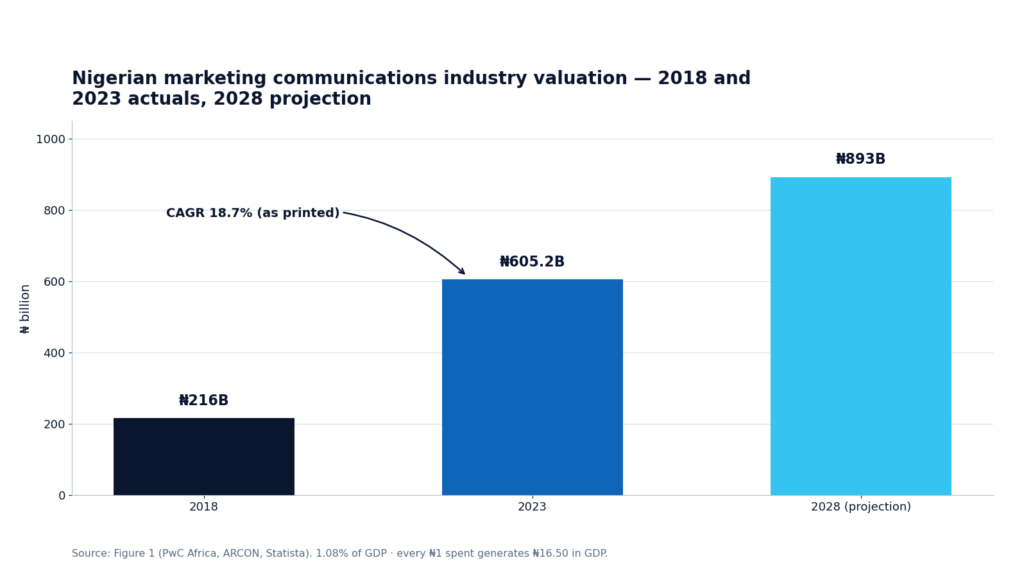
The marketing communications industry expanded from ₦216 billion in 2018 to ₦605.2 billion in 2023 — an 18.7% CAGR that significantly outpaces GDP growth. According to PwC Africa, every ₦1 spent on marketing communications generates a ₦16.50 GDP multiplier, stimulating media, technology, retail and manufacturing.
| Digital highlight | Value |
|---|---|
| Digital advertising 2025 | $340M · +8.5% · 34.2% of total spend |
| Internet users | 122.5M — about 50% of the population |
| Online video advertising growth | +49.1% — fastest channel |
Table 2 · Digital advertising channels, 2025
| Channel | 2025 value | Growth | Share of digital |
|---|---|---|---|
| Online video advertising | $161M | +49.1% | 47.4% |
| Social media advertising | $131M | +21.0% | 38.5% |
| Programmatic advertising | $241M | +11.0% | 71.0% of total digital |
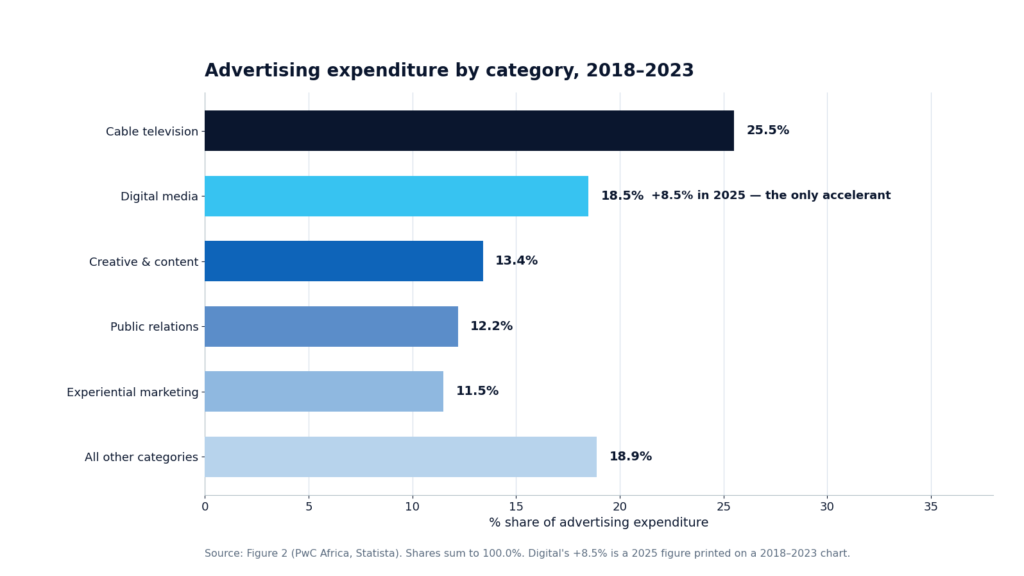
Cable still commands a quarter of spend — digital is closing in
Traditional broadcast media still dominates expenditure even as digital channels gain ground — a mix now under stress as the cost of broadcasting itself inflates.
The industry bodies
ARCON — The apex regulator — standards, accreditation and policy. Its Audience Measurement initiative and GDP Multiplier Effect report are professionalizing the industry and anchoring investment decisions.
AAAN — Association of Advertising Agencies of Nigeria — represents 200+ registered agencies, providing professional development and advocacy.
BON & MIPAN — Broadcasting Organisation of Nigeria — umbrella body for broadcast stations; MIPAN represents media planning and buying professionals.
ARCON’s strategic initiative
“We cannot continue to guesstimate the size of the industry. This report lays the foundation for us to assess the advertising space and its multiplier effect on the economy every year going forward.” — Dr. Olalekan Fadolapo, ARCON Director General
4. PMS prices & media house OPEX
Every litre of petrol now costs what five did in 2023
Fuel subsidy removal in mid-2023, compounded by the war’s pressure on global crude, created a perfect storm for businesses dependent on petroleum products. For energy-intensive media houses, the price trajectory reads as an operating crisis.
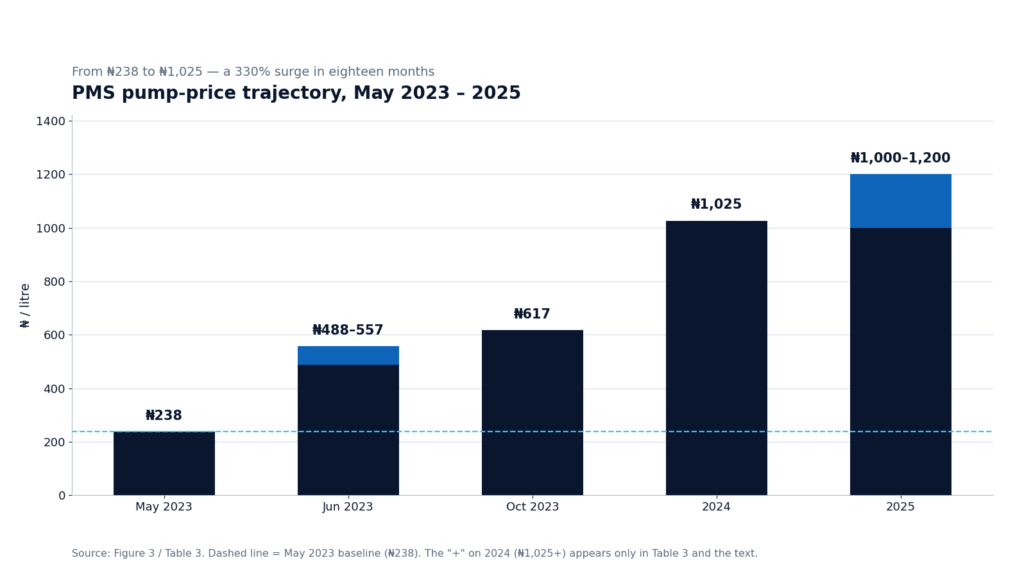
Table 3 · PMS price trajectory and triggering factors
| Period | PMS price (₦/litre) | Change | Triggering factor |
|---|---|---|---|
| May 2023 | ₦238 | Baseline | Pre-subsidy removal |
| June 2023 | ₦488–557 | +105–134% | Subsidy removal |
| October 2023 | ₦617 | +159% | Global price adjustment |
| 2024 | ₦1,025+ | +330% | Conflict escalation |
| 2025 (current) | ₦1,000–1,200 | +320–404% | Exchange rate volatility |
Key insight
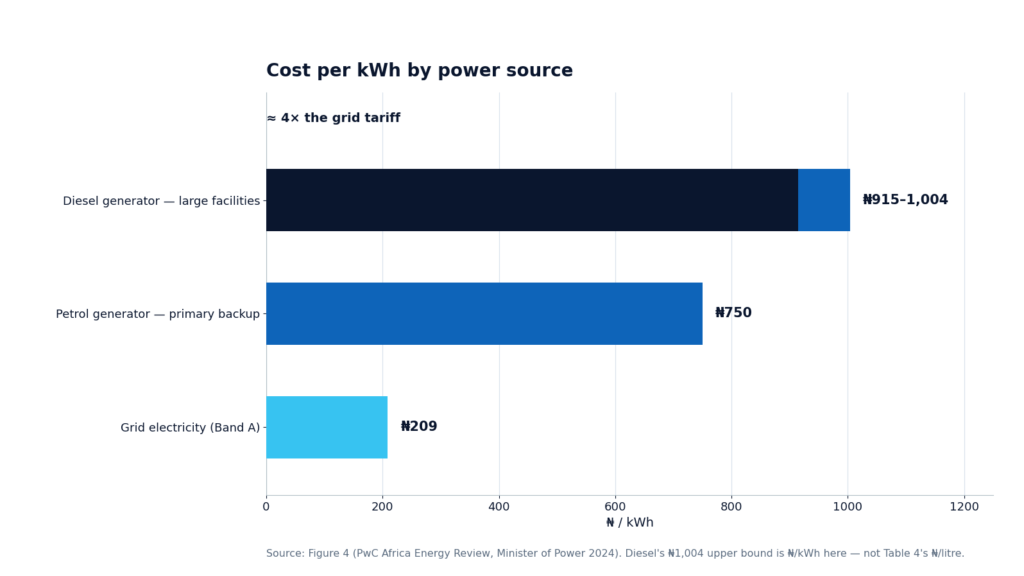
Running diesel generators costs approximately 4 times more per kWh than grid electricity. With the national grid utilizing only 31% of generated capacity and delivering notoriously unreliable service, media houses face an impossible choice between unreliable grid power and prohibitive generator costs.
Self-generated power costs four times the grid
The energy cost structure reveals a stark disparity: the grid is the cheapest source of power — and the least available. Broadcast transmitters, production studios and 24/7 monitoring systems cannot run on 20–30% availability.
Reduced transmission hours
Hot 98.3 FM Abuja — daylight hours only. Women Radio 91.7 Ogun — overnight broadcasts suspended. Multiple state TV stations — down from 24/7 to 12–16 hours daily.
Workforce & facility adaptations
Agencies now run work-from-home every other day to cut diesel burn — with consequences for creative collaboration. Event centres offer tiered pricing: no-AC events priced well below climate-controlled options.
Industry perspective
“The cost of diesel has become the single largest operational expense for our station, exceeding salaries and content acquisition combined. We’ve had to make painful decisions about programming and staffing.” — Station Manager, Lagos-based FM broadcaster
The monthly energy bill quadrupled
For a medium-sized broadcast station of 50–100 staff, the operational expenditure impact has been severe across every energy line item.
Table 4 · OPEX impact breakdown — medium-sized broadcast station, monthly
| Cost category | Pre-2023 | Current | Increase |
|---|---|---|---|
| Diesel (litres) | ₦250/litre | ₦700–1,004/litre | +180–302% |
| PMS (litres) | ₦185/litre | ₦1,000–1,200/litre | +441–549% |
| Generator maintenance | ₦500,000 | ₦1,200,000 | +140% |
| Total energy costs | ₦2–3 million | ₦8–12 million | +300–400% |
Why this matters beyond the station gate
Energy is now the largest single cost line for broadcast facilities — ahead of salaries and content. Every programming decision, rate-card negotiation and hiring plan is being made against an energy bill that has quadrupled in under three years.
5. Media monitoring & research agencies
The sector’s auditors are paying the same energy bill
Media monitoring agencies underpin the entire advertising ecosystem — ad tracking, compliance verification, audience measurement, campaign effectiveness analysis and proof-of-play documentation. Their 24/7 technological demands make the energy crisis especially punishing.
Core services
OOH campaign auditing — physical verification of billboard placements. TV & radio ad tracking — continuous broadcast monitoring. Digital monitoring — online ad tracking and sentiment analysis. Audience measurement and proof-of-play verification.
Key industry players
Retinaad Limited — adTech platform with RetiTrak AMC for outdoor monitoring. Webhaptic Intelligence — advertising research and digital analytics. MMS and MediaTrak — full-spectrum audit across TV, radio, print and outdoor. ARCON AMS — industry-wide audience measurement standardization.
Table 5 · Operational challenges for monitoring & research operations
| Operational area | Challenge | Cost impact |
|---|---|---|
| 24/7 monitoring systems | Cannot interrupt continuous capture | Generators must run constantly |
| Data centre operations | Cooling requirements + power redundancy | +280% energy costs |
| Field audit teams | Transportation for OOH verification | +185% mobility costs |
| Server infrastructure | Vulnerability to power fluctuations | UPS + generator redundancy required |
The underinvestment risk
Despite industry growth, advertising research remains significantly underfunded. Rising infrastructure costs squeeze exactly the capability — verified measurement — that the sector needs to defend advertising ROI in a constrained-budget era.
6. Consumer purchasing power — the erosion effect
Inflation ate the audience before it ate the budget
Headline inflation peaked at 34.19% in June 2024 — the highest in nearly two decades — fundamentally altering consumer purchasing behaviour and, with it, advertising effectiveness.
| Inflation marker | Value |
|---|---|
| Inflation peak | 34.19% — June 2024, two-decade high |
| 2024 CPI annual variation, post-rebasing | 31.7% |
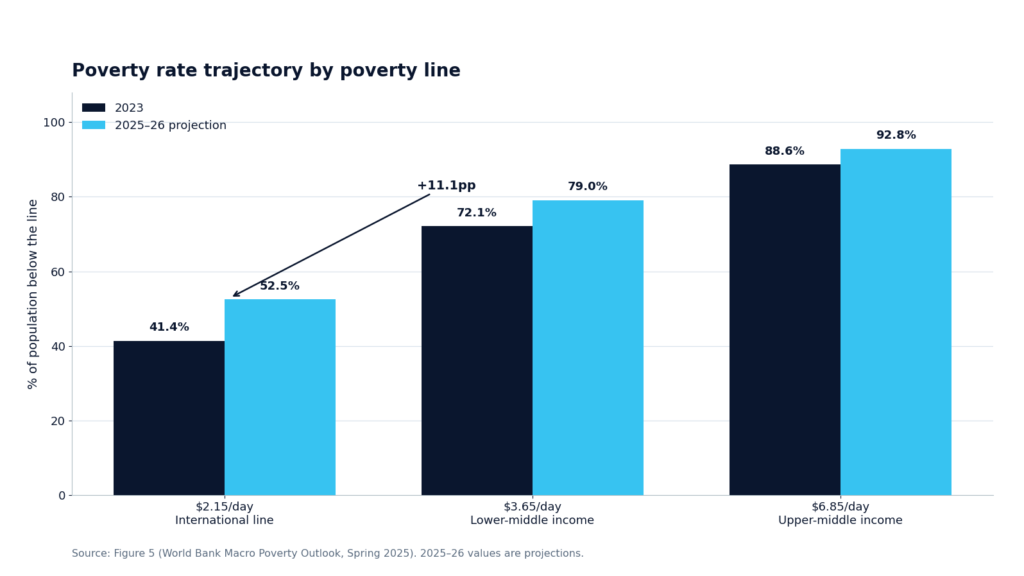
| Projected 2026 poverty rate at $2.15/day | 52.5% |
CPI rebasing — the statistical vs reality gap
The 2025 CPI rebasing cut reported inflation from 34.8% to 24.28% — a 10.32 percentage-point adjustment, the largest such revision globally. Statistically valid, it nonetheless masks the real cost-of-living pressure households experience daily.
The basket changed — and so did the buyer
The rebased CPI basket itself tells the story: households now spend materially more of their income on health, transport and education — leaving less for everything advertising sells.
Table 6 · CPI basket weight changes and category price increases
| Category | Old weight | New weight | Price increase |
|---|---|---|---|
| Healthcare services | 3.2% | 6.5% | +103.3% |
| Transport | 6.5% | 10.7% | +64.6% |
| Education | 4.1% | 6.5% | +59.0% |
| Restaurants & accommodation | 3.8% | 4.1% | +975.0% |
Consumer behaviour shifts
Reduced discretionary spending — households are cutting non-essentials across categories, directly hitting conversion for premium brands. Food budget reallocation — beans and eggs, the traditional low-cost proteins, are increasingly unaffordable. Transport burden — the CPI transport weight jumped from 6.5% to 10.7% as PMS increases pass through to fares, constraining mobility to retail and service locations.
Implications for advertising effectiveness
Reduced transmission hours shrink campaign reach; brand budgets face higher costs for lower effectiveness; and advertisers are shifting decisively to performance marketing with measurable outcomes. Research indicates a 73.8% correlation between fuel subsidy removal and inflation increases — with the conflict adding further upward pressure on oil, the sector must adapt to a consumer whose purchasing power continues to contract.
7. Sectoral interconnections & ripple effects
One shock, three amplifications
The war’s impact on Nigeria’s marketing sector operates through a clearly defined transmission chain — each link amplifying the effect on downstream participants.
Upstream
Global crude surge (+67% from $72 to $120+) · Strait of Hormuz disruption of 20M barrels/day · Nigeria’s import dependency despite oil-producer status · PMS deregulation removing the price stabilizer.
Midstream
Media house OPEX inflation (+280–320% on energy) · reduced broadcast hours and service quality · research agency infrastructure cost pressure · technology reliability challenges.
Downstream
Consumer purchasing power erosion (52.5% poverty projected) · reduced advertising effectiveness and ROI · brand budget reallocation to performance channels · shift from brand building to direct response.
The vicious cycle
Rising PMS prices inflate production costs → media houses cut output and hours → advertising reach declines → brands reduce spend → media revenue falls further → cost-cutting intensifies → industry contraction. Breaking this loop requires intervention at the energy layer, not the creative layer.
Cross-sectoral stakes
The sector employs over 50,000 professionals directly, with downstream effects across creative services, production and technology. The ₦16.50 GDP multiplier means sector contraction ripples economy-wide — through tax revenue, investment climate and the diversification agenda. The convergence of energy inflation, consumer erosion and digital disruption is an existential challenge for traditional media business models: without strategic intervention, expect significant consolidation and capacity reduction over 2025–2028.
8. Recommendations & strategic implications
Adapt the cost base, then the model
The strategic response runs on four tracks — operator, infrastructure, policy and advertiser — coordinated through a single industry body.
Media houses & broadcasters
— Energy diversification — solar-hybrid systems cut OPEX 60–70% within three years — Operational restructuring — consolidate prime-time, trim off-peak transmission — Revenue innovation — premium digital subscriptions for 122.5M internet users
Monitoring & research agencies
— Cloud migration — distributed processing cuts energy cost and infrastructure vulnerability — AI-powered automation — machine learning for ad detection and compliance, reducing field-audit frequency
Policymakers & regulators
— Refinery capacity — fast-track rehabilitation to end import dependency — Sector stabilization fund — concessional loans for energy infrastructure upgrades — Grid reliability — prioritize broadcast corridors to cut generator dependency
Advertisers & brands
— Performance-based budgeting — ROI-driven planning over reach metrics — Measurable channels first — prioritize digital with precise attribution — Value-sensitive creative — messaging calibrated to a constrained wallet
The Joint Industry Body (JIB) — immediate actions
Coordinated action across broadcasters, agencies and advertisers is now critical. 1. Convene industry stakeholders to establish the JIB governance structure. 2. Develop collective procurement for energy solutions and shared infrastructure investments. 3. Adopt unified measurement standards. The JIB model has proven successful in comparable markets — collective bargaining mitigates individual vulnerability.
9. Conclusion & future outlook
Resilience is proven — protection is not
Four conclusions emerge from the research. Together they describe a sector that absorbs geopolitical shock, pays dearly for it in operating cost, and passes the residue down to the Nigerian consumer.
1 · Direct transmission confirmed
The conflict reached Nigeria through a single channel — the Strait of Hormuz — and one commodity: crude. PMS rose +330% from the May 2023 baseline, and media-house OPEX escalated +280–320% as diesel and petrol generation replaced an unreliable grid.
2 · Operational disruption is structural
Stations now run at roughly 31% of installed capacity, trimming off-peak transmission, consolidating prime time and shifting staff to remote work. Energy — not talent, not content — is the binding constraint on output.
3 · Consumers absorb the residue
Inflation peaked at 34.19% and poverty at the $2.15 line is projected to reach 52.5% by 2025–26. Real media budgets shrink as households prioritise food, transport and energy — eroding the very audiences advertisers pay to reach.
4 · The sector’s engine still runs
Every ₦1 of advertising spend generates ₦16.50 in GDP, and the sector is projected to grow from ₦605.2B (2023) to ₦893B by 2028 — a 18.7% CAGR. Demand for accountable, measurable media is accelerating through the crisis, not despite it.
Scenario outlook — 2026 to 2028
Optimistic — Energy relief — PMS falls below ₦800 as refinery output scales. Growth holds — sector reaches ₦893B by 2028; digital nears 45% of spend. JIB succeeds — collective procurement cuts member energy cost.
Base case — Sticky prices — PMS holds ₦900–1,100; OPEX stays elevated. Moderated growth — nominal expansion continues, real margins compress. Gradual reform — solar-hybrid adoption spreads station by station.
Pessimistic — Hormuz closes indefinitely — PMS breaches ₦1,500. Broadcast contraction — 40% of stations cease 24-hour operations. Sector shrinks — industry value contracts toward ₦450B.
Final reflection
A conflict 4,500 kilometres away repriced Nigerian airtime, rewired station economics and compressed consumer wallets — proof that no market is an island. The ₦16.50 GDP multiplier makes the health of this sector not merely an industry concern, but a national economic priority. The strategic response must be as integrated as the threat: energy resilience at the station, measurement discipline at the agency, and coordinated policy at the centre.
References
- 1. PwC Africa (2024). Nigeria’s Advertising Industry: GDP Multiplier and Economic Impact Assessment. PwC Nigeria Entertainment & Media Outlook series.
- 2. World Bank (2025). Macro Poverty Outlook for Nigeria — Spring 2025. Poverty projections at $2.15, $3.65 and $6.85 lines.
- 3. National Bureau of Statistics (2025). CPI Rebasing Report: Methodology and Revised Weights. NBS, Abuja.
- 4. Krestel Digital (2025). Nigerian Digital Advertising Spend Report 2025. Channel-share and growth estimates.
- 5. FocusEconomics (2025). Nigeria Economic Outlook — Commodities and FX Consensus Forecasts.
- 6. International Monetary Fund (2025). World Economic Outlook Database. Nigeria GDP, inflation and external-sector series.
- 7. World Economic Forum (2026). Global Risks Report 2026. Geoeconomic confrontation and energy-supply risk assessments.
- 8. Advertising Regulatory Council of Nigeria — ARCON (2024). Advertising Industry Statistics and Audience Measurement Framework.
- 9. Statista (2025). Advertising and Media Market — Nigeria Country Dossier.
- 10. PwC (2024). Nigeria Energy Review: Tariffs, Diesel Parity and Distributed Generation.
- 11. Federal Ministry of Power (2024). Ministerial Briefing on Grid Availability and Band A Tariff Structure. Abuja.
- 12. Trading Economics (2025). Nigeria — Pump Price, Diesel and Inflation Time Series.
- 13. Retinaad (2025). RetiTrak Audience Measurement & Compliance Monitoring — Methodology Note.
About the author
Jim Ikpehai — Managing Consultant · Mediology Nigeria Limited, Lagos
Results-driven marketing communications strategist with over 15 years of experience in brand building, brand development and management. A trusted consultant to global and local brands including Samsung, Reliance HMO, Polo Swarovski, FBN Holdings, M-KOPA, Honda Nigeria, Daraju Industries and De Trans — delivering 360° marketing, communication strategies, media planning and buying, digital marketing, SEO, content strategy and marketing analytics.
Education — Ph.D. Economics — Sustainable Growth & Development (in view), University of Lagos; M.Sc. Economics — Growth & Development, Monetary & Energy Economics, University of Lagos; B.Sc. Economics — University of Lagos; Level 6 Diploma in Strategic Marketing — Chartered Institute of Marketing (CIM), UK.
Career highlights — Managing Consultant — Mediology Nigeria Ltd (2025–present); Director of Planning & Strategy — Solid Media Nigeria (2022–2025); Head, Media Planning & Strategy — HoiSales Nigeria (2020–2022); Head, Planning / Insight & Analytics — All Seasons Zenith (Publicis Groupe), Lagos (2014–2020); Senior Manager, Research / Planning & Innovation — All Seasons Zenith (Publicis), 2013–2014; Manager, Data Analytics & Innovation — MediaCom (WPP), 2011–2013.
Memberships & recognition — Juror, Young Lions National Competition (Cannes Lions pathway) — 2024 & 2025; Juror, Pitcher Awards — 2024; Panelist, Social Media Week Lagos — 2019; Fellow, Institute of Management Consultants of Nigeria (FIMC); Associate Member, Advertising Practitioners Council of Nigeria (APCON); Member, Chartered Institute of Marketing (CIM), UK.
15+ years in marketing communications · WPP · Publicis global network experience · ALAT launch team — Nigeria’s first digital bank · 2× Young Lions Juror · 2024 & 2025.
jim@mediologyng.com · +234 703 630 0230 · linkedin.com/in/jimikpehai75564295
See our Services page for the six integrated disciplines behind this approach.
Frequently asked questions
How did a war 4,500 kilometres away hit Nigeria’s marketing sector?
Through the Strait of Hormuz: the conflict disrupted a channel moving 20 million barrels of crude a day, Brent crude repriced from $72 to over $120 a barrel, and — because Nigeria imports over 90% of its refined petroleum despite being an oil producer — PMS surged 330%, from ₦238 a litre in May 2023 to ₦1,025+ in 2024.
How much have media houses’ energy costs risen?
Diesel generation costs roughly four times the Band A grid tariff per kWh, and total energy costs for a medium-sized broadcast station have quadrupled — from ₦2–3 million a month before 2023 to ₦8–12 million now. Stations have cut transmission hours in response: Hot 98.3 FM Abuja runs daylight hours only, and Women Radio 91.7 Ogun has suspended overnight broadcasts.
What has happened to consumer purchasing power?
Headline inflation peaked at 34.19% in June 2024, the highest in nearly two decades, and poverty at the $2.15-a-day line is projected to reach 52.5% by 2026. The rebased CPI basket shows households spending materially more on health, transport and education — leaving less for everything advertising sells.
How big is the sector, and what is it worth to the economy?
The marketing communications industry was worth ₦605.2 billion in 2023, up from ₦216 billion in 2018, and is projected to reach ₦893 billion by 2028. Every ₦1 spent on marketing communications generates ₦16.50 in GDP, and the sector employs over 50,000 professionals directly.
Where can I get the full report?
The full 18-page journal, The Impact of the Iran-Israel War on Nigeria’s Marketing & Advertising Sector, is available to download below. For a tailored reading of the findings for your business, or a sector-level deep dive, contact Mediology Nigeria at info@mediologyng.com or visit 1 Montgomery Road, Yaba, Lagos.
This report was prepared by Jim Ikpehai, Mediology Nigeria — data-driven marketing communications excellence. For the full analysis, including every market ranking and the underlying data, download the complete report below.